

“Will I be flat?” is the question I get before anything else when a patient comes in to discuss taking her implants out. Usually before recovery, before cost, before scars.
It’s worth saying what the honest answer looks like, because most of what’s written about this is reassurance with nothing underneath it. Some women do look deflated afterwards. Others barely change. The difference between those two outcomes isn’t luck, and a surgeon who has examined you should be able to tell you roughly which one you’re looking at before you book anything.
Here’s what actually determines it.
Most women having an explant aren’t doing it for looks
A series of 841 explant patients published in the Aesthetic Surgery Journal Open Forum in 2026 recorded why they wanted their implants out. Just over half, 51.7%, cited systemic symptoms or health concerns. Another 19.7% simply didn’t want implants any more.
That’s worth sitting with for a second. Appearance is rarely the reason women reach this decision, but it’s almost always the thing they’re anxious about on the way to it. Those are two different problems, and the second one is more manageable than it feels at the consultation.
What decides how you’ll look
Four things, roughly in order of how much they matter.
How much breast tissue you had to begin with. This is the big one. An implant doesn’t replace your tissue, it sits behind it. If you had a reasonable amount of your own tissue before augmentation, that tissue is still there and you will come back to something close to your starting point. If you were very small before implants, you’ll be very small after them, because there was never much to return to.
Implant size relative to that tissue. A 250cc implant behind a B cup is a different situation from a 500cc implant behind an A cup. Large implants on thin tissue stretch the skin envelope and thin the tissue further over years. The bigger the mismatch, the more empty space is left when the implant comes out.
How long they’ve been in. Tissue under sustained pressure thins. Ten or fifteen years of a heavy implant does more of this than three years of a modest one. It is not reversible, though it is often less severe than patients fear.
Your skin. Younger skin with good elasticity tightens back down considerably. Skin that has been through pregnancies, significant weight change, or a couple of decades of stretch retracts less and more slowly. Smoking makes this worse.
None of that requires guesswork. I can examine you, measure the tissue, look at your implant records and your history, and give you a realistic picture. If someone tells you confidently that you’ll look great without doing that, they’re guessing.
Skin retraction takes longer than anyone expects
This is where patients get frightened unnecessarily.
The first few weeks after an explant are the worst your chest will look. There’s swelling in odd places, the skin hasn’t begun to tighten, and everything sits lower than it will. Women who look at themselves at two weeks and panic are looking at a stage, not a result.
Retraction happens over months. There’s meaningful change through the first three months, and it continues more slowly out to about a year. At six months you have a fair idea of where you’ve landed. At twelve you have the answer.
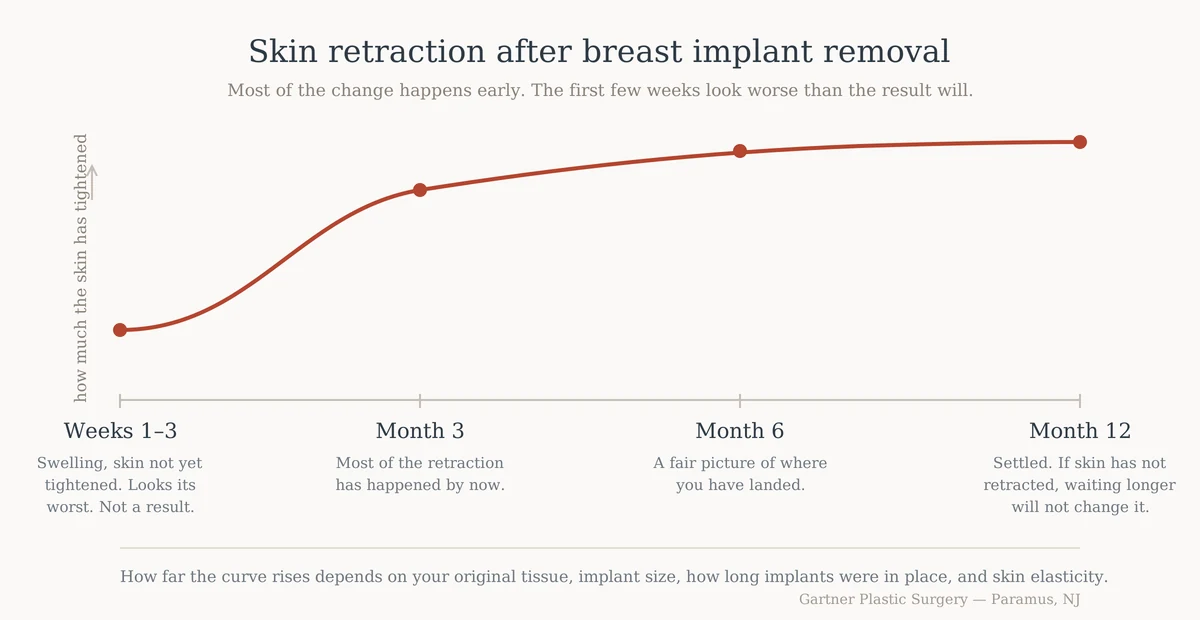
What I won’t promise is that skin always comes back. Some does, some doesn’t, and the amount depends on the four things above. If your skin has limited elasticity, waiting a year won’t change that, and the useful conversation at that point is about a lift rather than more patience.
Do you need a lift at the same time?
This is the real decision, and it’s the one competitors tend to skate past.
Removing implants and lifting at the same operation is a well-established approach. In that series of 841 patients, all of whom had both done together, complications occurred in 4.76% and revisions in 4.63%. There were no cases of nipple or areola tissue loss. Those are reassuring numbers for a procedure patients often assume is high risk.
A couple of details from the same data are worth knowing. The most common revision was a small correction at the end of the incision, in about 1.5% of patients. And women who’d already had two or more previous lifts had a substantially higher chance of needing a revision, which is a real consideration if you’ve been through this before.
The honest limitation: average follow-up in that study was about five and a half months, and the authors didn’t collect formal satisfaction scores. It tells you about safety, not about how happy people were with the look.
Doing both at once means one recovery and one set of scars, and you see your final shape far sooner. The argument for waiting is that you find out what your skin does on its own first, and some women discover they don’t want a lift at all. I’d rather make that call with you at an exam than apply a rule. If a lift is on the table, our guide to breast lift scars covers which incision pattern your anatomy calls for and what it looks like over the first year.
What fat transfer can and can’t do
Patients ask about this constantly, usually hoping it’s a way to keep some volume without implants.
It can help. Fat is taken from somewhere you don’t want it, processed, and placed into the breast. It softens the transition and restores some fullness, and because it’s your own tissue it ages with you.
The limits are real though. A session adds modest volume rather than replacing a 400cc implant. Some of the transferred fat doesn’t survive, which is normal and planned for, so more than one session is often needed. And you have to have enough fat somewhere to harvest, which rules out some of the thinnest patients, who are frequently the ones most worried about looking flat. That’s an awkward trade-off and I’d rather name it than let someone discover it at the consultation.
Choosing to stay flat
Some women decide they don’t want a lift, don’t want fat transfer, and are finished with the whole project. That’s a legitimate choice rather than a failure of the surgery, and there’s an established community of women who’ve made it deliberately.
If that’s where you’re heading, say so early. It changes how I plan the operation, particularly how the remaining skin is handled, and planning for a flat result from the start produces a better one than treating it as what’s left over when nothing else is done.
Questions worth asking at your consultation
Bring your implant records if you have them, including size, type, placement and the date of the original surgery. Those change the assessment.
Then ask directly: based on my tissue, what do you expect this to look like at six months? Would you recommend a lift now or waiting? If my skin doesn’t retract as much as we hope, what are the options and what do they cost? A surgeon who has examined you should answer all three without hedging.
Common questions
Will I be completely flat after breast implant removal?
Rarely completely flat, unless you had very little breast tissue before augmentation. The implant sits behind your own tissue rather than replacing it, so what you had before is largely what you return to. How close you get depends on your starting tissue, implant size, how long they were in, and your skin’s elasticity.
How long does skin take to retract after implant removal?
Most of the change happens in the first three months, continuing more slowly to around a year. The first few weeks look worse than the result will be. By six months you have a fair picture, and by twelve months it’s settled.
Should I have a lift at the same time as implant removal?
It depends on your skin quality and how much tissue you have. Doing both together means one recovery and one set of scars, and published outcomes for combined explant and lift report complication rates under 5%. Waiting lets you see what your skin does first. The decision should follow an examination, not a rule.
Can fat transfer replace my implants?
Partially. Fat transfer restores modest volume and softens the shape, but a single session does not replace a large implant, and some transferred fat is reabsorbed so more than one round may be needed. You also need enough fat elsewhere to harvest.
Does insurance cover breast implant removal?
Sometimes, when removal is medically necessary, for example with rupture or capsular contracture. Removal for personal preference is treated as cosmetic. Coverage depends entirely on your plan and documentation, so verify it directly with your insurer before scheduling.
Talk it through in Paramus
If you’re considering explant and want a realistic answer rather than a comforting one, that takes an examination and about twenty minutes. Our office is on Winslow Place in Paramus.
To discuss breast implant removal in New Jersey, call (201) 546-1890 or request a consultation. If your reason for removal is a hardened implant, our guide to capsular contracture explains how that’s graded and treated.
Medically reviewed by Dr. Michael Gartner, DO, FACS — double board-certified plastic surgeon and Fellow of the American College of Surgeons, practicing in Paramus, New Jersey.