Patients ask me about breast lift scars before they ask me about anything else. Not recovery, not cost. The scar.
That’s a reasonable thing to lead with, and most of what’s written about it online isn’t much help. The standard article tells you there are three incision patterns, that your surgeon will pick one, and that scars fade with time. All of that is true. None of it answers the question you’re actually asking, which is what yours will look like and when.
So here’s how it works, starting with the part that surprises people.
You don’t choose your scar pattern. Your anatomy does.
What determines which incision you need is the position of your nipple relative to the crease underneath your breast. That crease has a name, the inframammary fold, and surgeons treat it as a fixed landmark because it doesn’t move much over a lifetime. Breast tissue descends. The fold stays roughly where it is.
Plastic surgeons grade ptosis — the clinical word for sagging — against that landmark, using a system that goes back to a 1976 paper by Paule Regnault and is still the standard today:
- Nipple sitting level with the fold: mild, grade one.
- Nipple below the fold but still not the lowest point of the breast: moderate, grade two.
- Nipple below the fold and pointing down, the lowest thing on the breast: severe, grade three.
- Nipple at or above the fold with most of the breast volume hanging below it: pseudoptosis, which is common after breastfeeding.
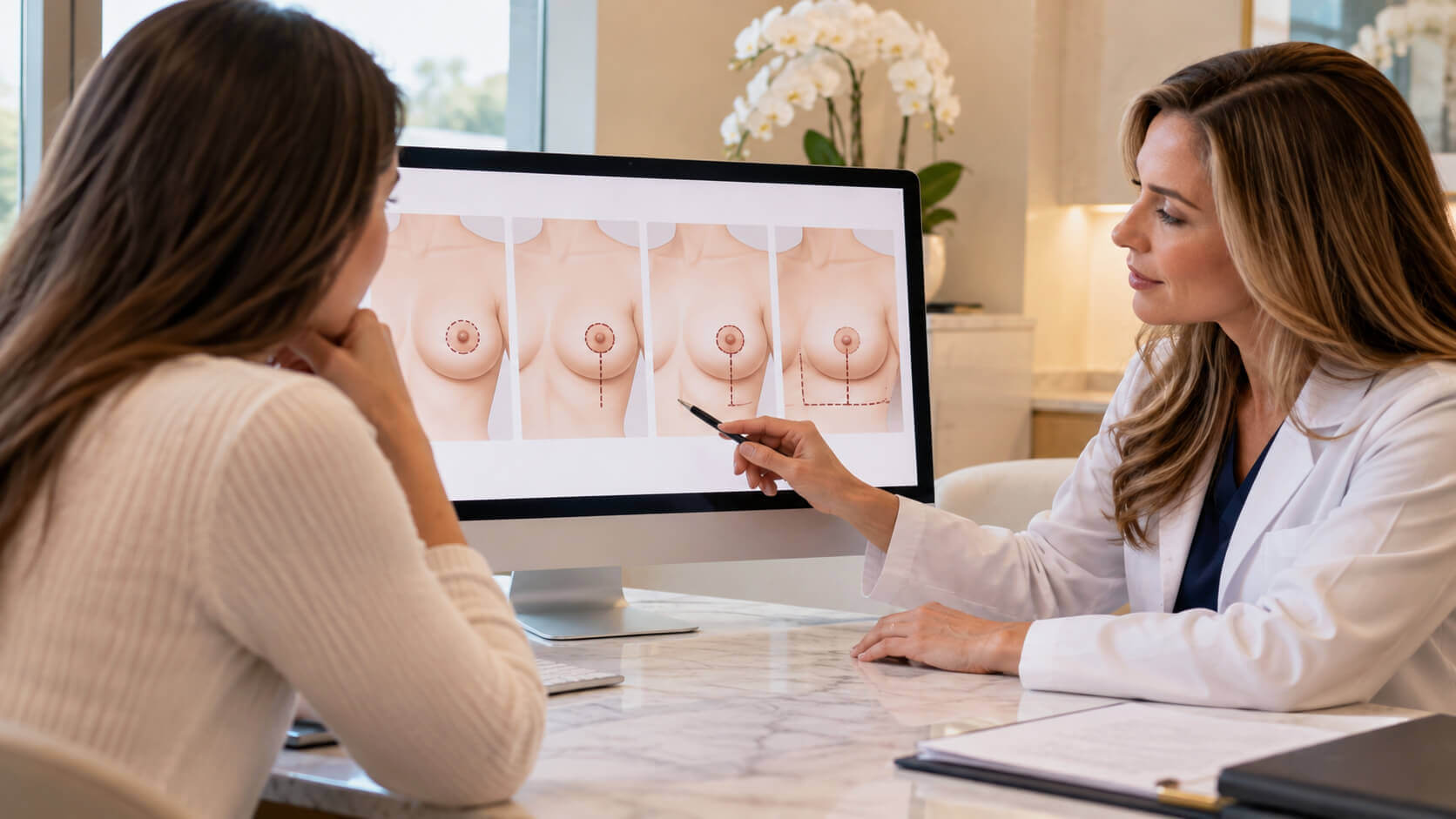
At your consultation I measure the distance from your nipple to the fold, check where the fold sits against your chest, and assess how much loose skin there is and how much elasticity is left in it. Those numbers pick the pattern. Not preference, and not a result someone saw on Instagram.
This comes up because patients sometimes arrive asking for the smallest possible scar, which is a completely understandable thing to want, and occasionally I have to explain that the small scar won’t do the job. There’s a reason for that beyond surgical caution, and I’ll get to it below.
The four patterns
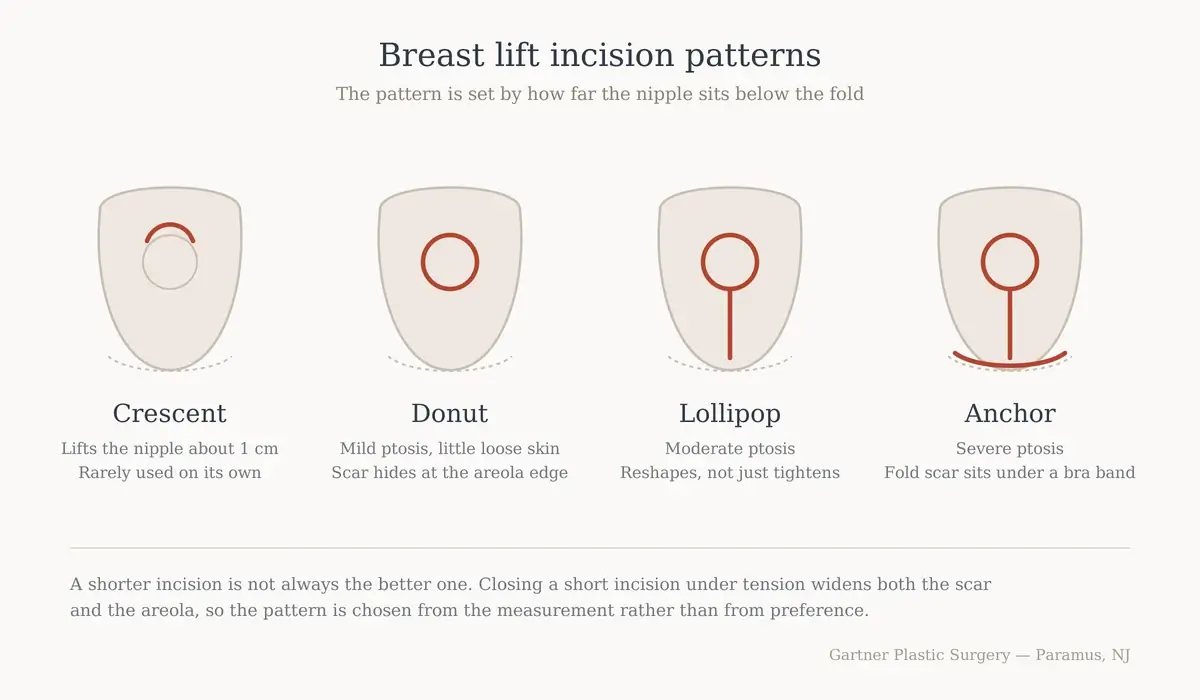
Crescent. A thin sliver of skin removed above the areola. It raises the nipple by roughly a centimeter. I almost never use it on its own, because a centimeter is rarely what anyone came in for. It shows up occasionally as a small correction alongside an augmentation.
Donut, or periareolar. A circle around the edge of the areola. The scar hides in the color change between areola and skin, which is the best natural camouflage available anywhere on the breast. It suits mild ptosis where the nipple needs to come up two centimeters at most and there isn’t much loose skin to take out. It can also narrow an areola that has stretched.
Lollipop, or vertical. The donut incision plus a vertical line from the bottom of the areola down to the fold. This handles most of the lifts I do. It lets me reshape the breast tissue rather than just tighten skin over it, and it works across a wide range of ptosis grades.
Anchor, or inverted-T. The lollipop plus a horizontal line along the fold. This is for severe ptosis and for breasts carrying a lot of skin relative to the tissue underneath. The horizontal portion sits down in the crease where a bra band or a bikini bottom covers it, but it is the longest scar of the four and there’s no point pretending otherwise.
If you’ve been reading about scarless or minimal-incision lifts, that’s a conversation worth having in person. The same marketing problem exists on the reduction side, which I went through in scarless breast reduction.
Why the smallest scar isn’t automatically the best one
Here’s the trade-off that rarely gets explained.
A donut incision closes a circle of skin by gathering it, like a purse string. Ask that circle to take up too much slack and two things follow. The areola widens over the next year, because the tension is pulling outward on it. The scar widens too, for the same reason.
A scar closed under tension gets broader and whiter as it matures; one closed without tension tends to stay thin. That is the most reliable predictor there is of how a surgical scar turns out, and it’s why I’d rather give a patient a longer incision that heals as a fine line than a short one that stretches into a pale band circling her areola.
So when the measurement says lollipop and the patient wants donut, the real choice is between a vertical line that will probably fade to something hard to spot and a circle that may end up more noticeable than the longer scar would have been.
What the first year actually looks like
Most articles compress this into “scars fade over time.” The real curve has a dip in it that catches people off guard, so it’s worth walking through properly.
Weeks one and two. The incisions are closed and dressed. Flat, a little pink, not much to look at. Patients at this stage often tell me the scars look great.
Weeks four through twelve. They get worse. This is the part nobody warns you about. Your body is laying down collagen to close the wound and it overshoots, so the scar thickens, raises slightly, and turns red or purple. Some patients get itching along the line. It’s normal, it’s the busiest phase of healing, and a scar that looks angry at month two is not a scar that is healing badly.
Months three to six. Redness starts coming down around now, and the scar softens and begins to flatten out. By the six-month mark most of my patients have stopped thinking about it, though it is still visibly a scar.
Months six to twelve. Fading continues, slowly. The color shifts from red toward pink toward something closer to your own skin tone, and the texture keeps improving.
Year one to two. The scar is mature somewhere between twelve and eighteen months. Final appearance is usually a thin pale line. It does not disappear, and I’d be lying if I told you it did.
One thing that gets left out of these timelines: darker skin tends to hold pigment in a scar for longer, and the risk of a raised hypertrophic scar or a keloid is higher. That rules nobody out of a lift. It does mean the plan should account for it from the first visit rather than after something has already gone sideways.
Creams, sheets, and what actually matters
Patients arrive with lists of scar products, so let me tell you what the evidence supports, including where it’s thin.
Silicone sheets and gels are the most studied option and they are what I recommend. That said, the Cochrane review of silicone gel sheeting found that the trials showing a benefit were of poor quality and highly susceptible to bias. The honest position is that silicone is probably worth using and nobody should promise you it will transform your scar. I suggest starting once the incision has fully closed, around two to three weeks, and staying with it for about three months.
Sun protection is less interesting and more reliably useful. Ultraviolet light hitting an immature scar drives pigmentation that can stay permanently. Keep it covered through the first year.
What matters more than any product: how the incision was planned, whether it was closed under tension, whether the deeper layers were supported so the skin isn’t carrying the weight of the breast on its own, and whether you avoided doing something in week three that pulled on the closure. Products help at the edges of that, and not a great deal more.
Smoking is the other variable worth taking seriously. Nicotine constricts the small vessels feeding the wound edge, and that shows up as delayed healing, wider scars, and in the worst cases tissue that doesn’t survive at all. I ask patients to stop four to six weeks ahead of surgery, and that includes vaping and nicotine patches.
If a scar isn’t settling
Sometimes one doesn’t, and a scar still thick, raised, and red at six months gets treated rather than waited out.
What we do depends on what’s happening. A hypertrophic scar often responds to steroid injection. Laser resurfacing can help with color and texture together. A scar that has widened past the point where either of those will do much can be cut out and closed again, which is among the approaches on our scar treatment page.
The one thing I’d ask is that you come in and let me look at it, rather than deciding from a photograph online whether yours is normal.
Having the lift done awake
Most of the lifts in my practice are done under oral sedation with local anesthesia instead of general. The procedure runs around three hours and you go home the same day. There’s more detail on the awake breast lift page.
For a conversation about scars, the thing to know is that skipping general anesthesia doesn’t change where the incisions go or how they heal. Your anatomy still dictates the pattern. What it changes is the recovery around them, and for patients who are anxious about being put under, it removes that worry from the decision entirely.
Common questions
How long do breast lift scars take to fade?
Most of the fading happens between months three and twelve, and the scar reaches its final appearance somewhere between twelve and eighteen months after surgery. Expect it to look worse rather than better between weeks four and twelve, which is the most active phase of collagen formation.
Which breast lift has the least scarring?
The donut or periareolar pattern leaves the shortest scar, hidden at the edge of the areola, but it only suits mild ptosis with a small amount of skin to remove. Choosing a shorter incision than your anatomy allows puts the closure under tension, which tends to widen both the scar and the areola.
Do breast lift scars ever go away completely?
No. A breast lift scar matures into a thin pale line that is usually hard to notice, but it is permanent. Surgeons place the incisions where clothing and the natural color change at the edge of the areola will conceal them.
Does silicone scar gel work after a breast lift?
Silicone sheets and gels are the most studied scar treatment and are worth using, though the published trials are of limited quality. Start once the incision has fully closed, usually around two to three weeks, and continue for about three months. Sun protection through the first year matters at least as much.
Is my scar pattern decided before surgery?
Yes. The pattern is determined at your consultation by measuring the distance from your nipple to the inframammary fold and assessing how much excess skin there is and how elastic it still is. You will know which incisions to expect before the day of surgery.
Talk through your options in Paramus
If you want to know which pattern your anatomy calls for, that takes a measurement and about fifteen minutes. Our office is on Winslow Place in Paramus, easy to reach from Route 17 and the Garden State Parkway for patients across Bergen County.
To discuss a breast lift in Paramus, NJ, call (201) 546-1890 or request a consultation. If you’re still weighing a lift against implants, breast lift vs. breast augmentation works through that decision.
Medically reviewed by Dr. Michael Gartner, DO, FACS — double board-certified plastic surgeon and Fellow of the American College of Surgeons, practicing in Paramus, New Jersey for over 20 years.