Some dog ears after a tummy tuck go away on their own, and some don’t. A pucker at the end of the scar is often swelling that flattens over the first few months. A true dog ear, made of extra skin or fat, usually stays, but a minor procedure can correct it once healing is complete.
So if you’re a few weeks out from your tummy tuck and you keep checking a small bump at the end of your scar in the mirror, the honest answer is that it’s too early to know which kind you have. Here’s how to tell, how long to give it, and what a fix looks like if you need one.
What is a dog ear after a tummy tuck?
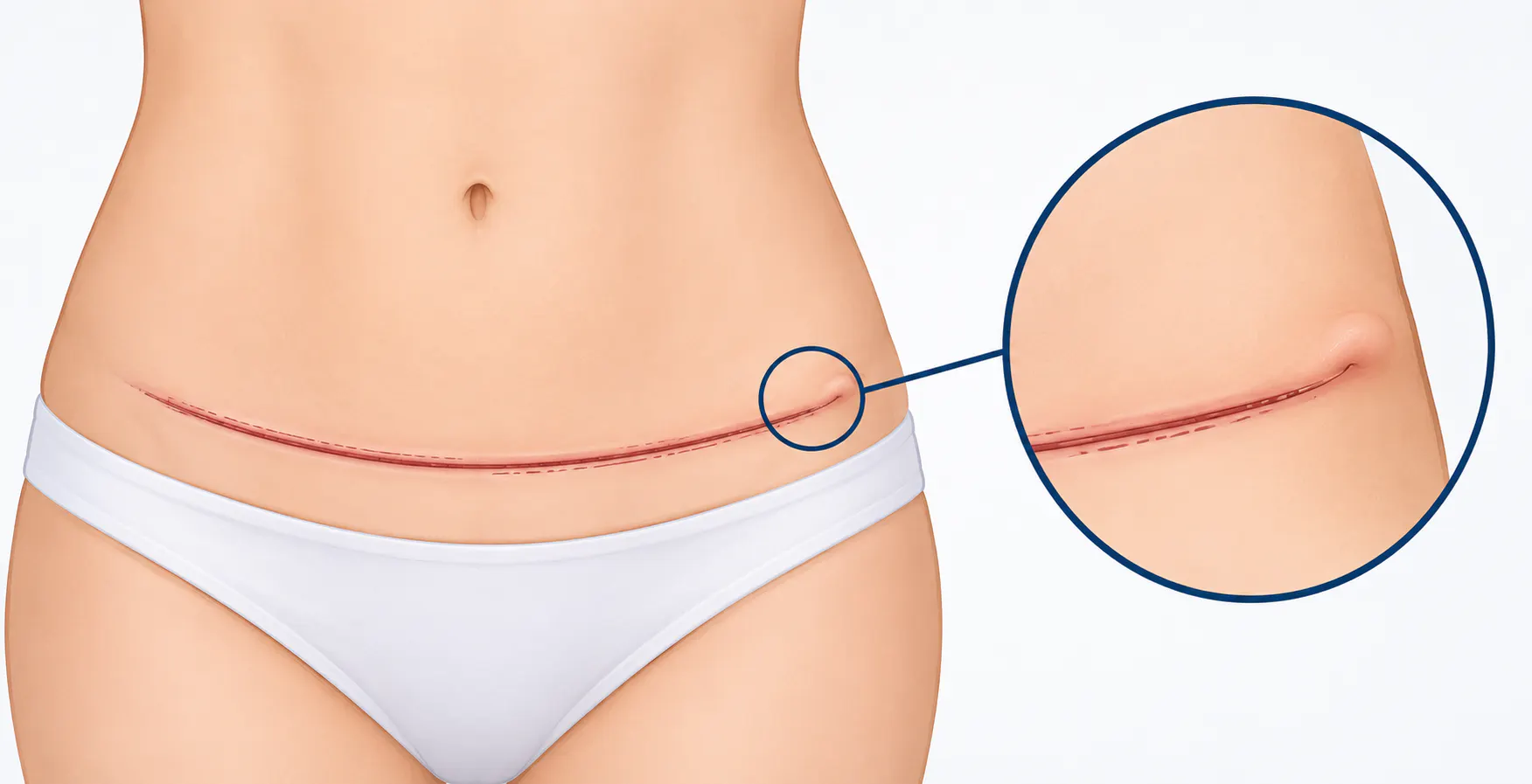
It’s a little cone of skin and fat that sticks up where the scar ends, usually at the hip. Surgeons also call it a standing cone.
A tummy tuck takes out a curved, crescent-shaped section of skin from the lower belly and pulls the upper skin down to close the gap. Through the middle the edges line up neatly. Out at the ends there’s often slightly more tissue on one side of the incision than the other, and that extra has nowhere to go, so it bunches into a point. The shorter the scar, the more likely that is.
How common are dog ears?
Common enough that most plastic surgeons mention them before surgery. In a review of 278 consecutive tummy tucks published in the Journal of Plastic, Reconstructive & Aesthetic Surgery, about 12% of patients developed dog ears and around 10% had them revised. A 2021 review in Seminars in Plastic Surgery lists dog ears among the usual reasons people come back for a touch-up after body contouring.
In other words, having one doesn’t mean your surgery went wrong. It’s mostly a side effect of trying to keep the scar short.
Is it swelling or a true dog ear?
In the first two or three months you often can’t tell, and neither can your surgeon with any certainty. Swelling after a tummy tuck likes to sit at the sides and the lower belly, which makes the scar ends look fuller than they’ll end up.
Swelling usually feels soft, looks about the same on both sides, gets puffier by evening and slowly shrinks from one month to the next. A true dog ear is different in a few ways:
- There’s a defined point or fold of skin right at the end of the scar
- It looks much the same at four or five months as it did at two
- It shows through leggings or above a bikini line
- You can pinch a small pocket of skin or fat right at the scar’s tip
Posture matters early on, too. Most people walk a bit bent over for the first week or two, which crowds the skin at the hips. Once you’re standing straight again, some of that fullness disappears on its own.
How long should you wait before fixing a dog ear?
Most plastic surgeons wait until swelling has fully settled and the scar has started to mature, which usually means several months. Fix it too early and you might be treating swelling that would have gone down anyway.
There’s a practical upside to waiting as well. Once the swelling is gone, what’s left at the end of the scar is only the true excess, so the correction tends to be smaller.
How are dog ears corrected?
It depends on what the bump is made of. If it’s mostly skin, the end of the scar is reopened, the extra skin is trimmed and the area is stitched flat. That lengthens the scar a little toward the hip, but the line usually ends up smoother. If it’s mostly fat, a small amount of liposuction can flatten it without making the scar any longer. Plenty of dog ears are a bit of both, so the two are often combined.
Many small dog ear corrections can be done under local anesthesia, and recovery is much easier than the original tummy tuck. Larger corrections, or ones done alongside other work, may need more. A correction is still a procedure, though, with its own small risks: a slightly longer scar, bleeding, infection, and the chance that the two sides still look a little uneven and need a further tweak.
Our scar revision page explains how scars are improved more generally, including cutting out an old scar and closing the skin with less tension.
Can dog ears be prevented?
Not entirely. What helps most is planning the scar length around how much loose skin you have, and treating fullness at the sides during the tummy tuck itself.
Our tummy tuck page describes three types. A mini tummy tuck uses a much smaller incision for people with less loose skin. A standard tummy tuck runs roughly hip to hip. An extended tummy tuck runs from the far point of one love handle to the other, for people with a lot of excess skin. Many surgeons would rather give you a slightly longer scar that lies flat than a shorter one with a bump at each end, and that trade-off is worth talking through before surgery.
Liposuction of the hips and flanks at the same time can smooth the transition where the scar ends. Being at a stable weight before surgery helps as well, since fuller hips make the ends harder to taper. If you’re still planning your tummy tuck, ask at your consultation where your scar will end and why.
Getting a dog ear checked in Paramus and Bergen County
If you had your tummy tuck with Dr. Gartner, mention it at your next follow-up. He’ll look at the scar ends, tell you whether they’re still settling and plan a correction if one turns out to be needed.
If you had surgery somewhere else, it’s usually wise to start with your original surgeon, who knows exactly what was done. Our post on plastic surgery revision covers when that makes sense and when a second opinion is worth getting. Dr. Michael Gartner, DO, FACS, is a double board-certified plastic surgeon who has performed more than 25,000 procedures, and he sees revision patients from across Bergen County and northern New Jersey, including Ridgewood, Hackensack, Fair Lawn and Englewood, at our Paramus office.
For more on the surgery itself, see 5 things to know before getting a tummy tuck and how visible your surgical scars will be. You can also look through our tummy tuck before and after photos.
Frequently asked questions
Do dog ears after a tummy tuck go away on their own?
Some do. Fullness at the scar ends that is mostly swelling often flattens over the first few months. A true dog ear made of extra skin or fat usually stays and needs a minor correction once healing is complete.
How long should I wait before fixing dog ears after a tummy tuck?
Most plastic surgeons wait until swelling has fully settled and the scar has started to mature, which usually takes several months. Your surgeon will check the scar ends at follow-up visits and tell you when a correction makes sense.
Will exercise or losing weight get rid of dog ears?
Not usually. Exercise and weight loss can shrink fat across your whole body, but you can’t target one spot, and they won’t remove extra skin. A dog ear that is mostly skin needs to be trimmed.
Is dog ear correction a big surgery?
Usually not. Many small dog ear corrections can be done under local anesthesia by trimming the extra skin, using a little liposuction, or both. Recovery is much easier than the original tummy tuck.
Will fixing a dog ear make my scar longer?
If the dog ear is mostly skin, the scar is usually extended slightly toward the hip so it can lie flat. If it is mostly fat, liposuction can often flatten it without lengthening the scar.
Have a question about your tummy tuck scar? Book a consultation at our Paramus office or call (201) 546-1890.