
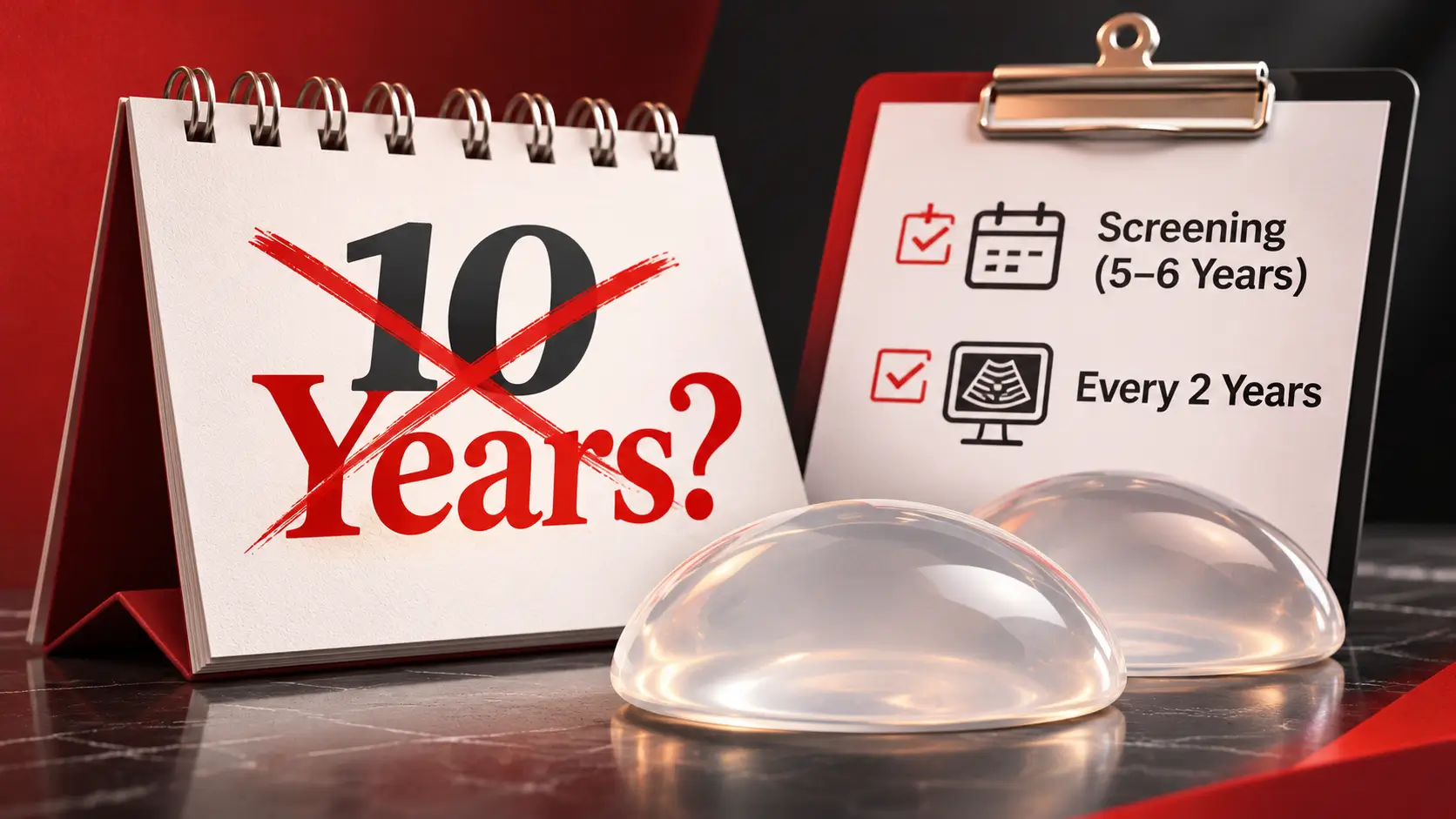
No. There is no ten-year expiry date on breast implants, and nothing from the FDA or any manufacturer says there is. Implants are replaced when there is a reason to replace them, not when a clock runs out. Plenty of women keep the same pair well beyond a decade without any problem.
The ten-year figure is one of the most persistent ideas in this field, and it causes real anxiety. Patients come in at year nine asking to book surgery they don’t need, and others ignore a genuine problem at year four because the calendar says they’re fine. Both are the same mistake.
Here is what actually governs this, including what the FDA does recommend, which is screening rather than replacement. If you already know something has changed and want the procedure itself, our breast implant revision page covers how that works.
Where did the ten-year idea come from?
It appears to be a conflation of two real things that aren’t replacement deadlines.
The first is manufacturer warranty terms, which run for a defined period and cover rupture under specified conditions. A warranty window is a commercial guarantee, not a statement about when a device stops working.
The second is the screening schedule, which is genuinely periodic and genuinely important, and which has at various points involved intervals that sound like a replacement cycle. Somewhere between those two, “check them regularly” turned into “swap them every ten years.”
I’d add a third factor, which is that the longer any device is in place, the more likely something will eventually prompt surgery. The FDA puts it plainly: the chance of developing complications increases the longer a patient has the implant. That describes a probability that rises gradually, which is a different thing from a date on which something is due.
What does the FDA actually recommend?
Screening for silent rupture, not scheduled replacement.
The FDA’s guidance is that patients without symptoms be screened using either ultrasound or MRI at **five to six years after implantation**, and then repeat that screening **every two years**. If you have symptoms, or if an ultrasound result is unclear, it recommends MRI.
The reason is that a silicone implant can rupture without you noticing. The shell fails, the cohesive gel largely stays where it is, and the breast can look and feel unchanged. That is what “silent” means here, and it is why imaging exists for this at all. Saline is different. A saline implant that ruptures deflates visibly within days, so it announces itself.
The FDA is also explicit that **breast implants are not lifetime devices**, and that additional surgery may be needed over time. Both statements are true at once: they will not last forever, and they do not expire on a schedule.
So when do implants actually get replaced?
When something specific has changed. In my practice the reasons fall into a short list.
Rupture. Confirmed on imaging, or obvious in the case of saline. This is the clearest indication.
Capsular contracture. The scar capsule around the implant thickens and tightens, making the breast firm, high or painful. Grades III and IV generally need surgical correction, which our guide to capsular contracture goes through in detail.
Wanting a different size. A completely legitimate reason, and a common one. Bodies and preferences both change.
Visible rippling or a palpable edge. Usually a tissue-coverage problem rather than an implant failure, and the fix often involves changing placement or implant type rather than simply swapping like for like. We covered why in implant rippling.
Position change. An implant that has drifted upward, outward, or below the fold.
None of those are calendar events. If none of them apply to you at year eleven, you don’t have a problem to solve.
How would I know if something has changed?
Most of the reasons above announce themselves, with the single important exception of silent rupture.
Firmness that wasn’t there before, a breast that sits higher than its partner, a change in shape, new discomfort, visible wrinkling along the edge, or an implant that has clearly moved. Any of those are worth an examination rather than a wait-and-see.
What you cannot detect yourself is a quiet shell failure in a silicone implant. That is precisely the gap the FDA screening schedule is designed to cover, and it’s the argument for following it even when everything feels completely normal.
If I do need surgery, is replacing them the only option?
No, and this is the part worth thinking about before you book anything.
Once the implants are coming out, there are three directions. You can replace them with new implants, sometimes taking the opportunity to change size, profile or placement. You can remove them without replacement. Or you can remove them and add a lift, which is what many women choose when the skin has stretched over the years.
That second option is chosen more often than patients expect, and the thing most people want to know before considering it is how they will look afterwards. Our guide to what determines your appearance after implant removal covers the four factors that decide it. You can also see outcomes in the before and after gallery.
Deciding which direction you want before surgery matters, because it changes the operation, the recovery and the cost.
What does replacement cost?
It depends on what is being done, and a straight implant exchange is not priced the same as an exchange with a capsulectomy or with a lift added.
Our published average fees for breast augmentation are $8,500 for saline and $9,500 for silicone under local anesthesia, and $9,500 and $10,500 respectively under general anesthesia, with augmentation and lift together running $12,000 to $15,000. Those cover the surgeon’s fee, facility, anesthesia and garments. The full list is on our pricing page, and the exact quote for your case is confirmed at consultation.
If the reason for surgery is rupture or capsular contracture rather than preference, it is worth asking your insurer whether any part is covered. Replacement for cosmetic reasons is not.
Common questions
Do breast implants expire?
No. Implants have no expiry date, and neither the FDA nor manufacturers state one. The FDA does say implants are not lifetime devices and that complications become more likely the longer they are in place, which is a different claim from a fixed replacement interval.
How often should I have my implants checked?
The FDA recommends ultrasound or MRI at five to six years after implantation and then every two years, to detect silent rupture in silicone implants. A symptomatic breast, or an unclear ultrasound, warrants an MRI regardless of where you are in that schedule.
Can I tell if a silicone implant has ruptured?
Often not. Cohesive gel tends to stay in place when the shell fails, so the breast can look and feel normal. This is why imaging is recommended. A ruptured saline implant is obvious, because it deflates within days.
Do I have to replace implants if I have them removed?
No. Removal without replacement is a common choice, and removal with a lift is another. How you will look afterwards depends mainly on how much breast tissue you had before augmentation, implant size, how long they were in, and your skin’s elasticity.
Does insurance cover implant replacement?
Generally only when the surgery is medically necessary, such as a confirmed rupture or capsular contracture. Replacement for a size change or personal preference is treated as cosmetic. Coverage depends on your plan, so verify it with your insurer before scheduling.
Have your implants assessed in Paramus
If you’re at year nine and worried, or year four and noticing something, the useful next step is an examination rather than a calendar. Bring your implant records if you have them, since manufacturer, size, placement and date of surgery all change the assessment.
Call (201) 546-1890 or request a consultation at our Paramus office.
References
- U.S. Food and Drug Administration. Statement on the agency’s continued efforts to protect women’s health and enhance safety information available to patients considering breast implants. Recommends ultrasound or MRI screening at five to six years post-implantation and every two years thereafter, and that labeling state breast implants are not lifetime devices.
Medically reviewed by Dr. Michael Gartner, DO, FACS — double board-certified plastic surgeon and Fellow of the American College of Surgeons, practicing in Paramus, New Jersey.