
“Scarless” is a marketing word, and I want to deal with that before anything else.
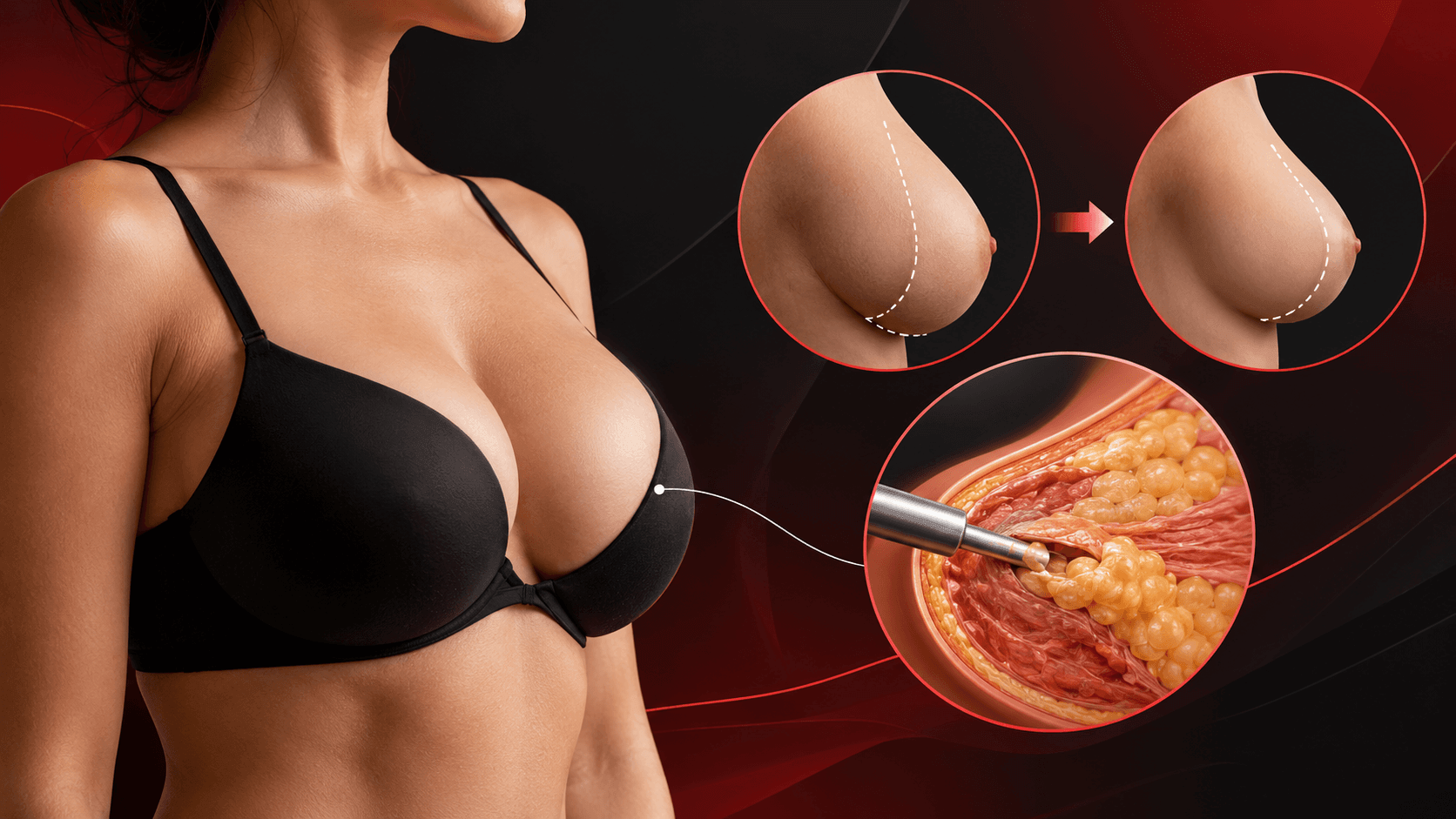
The procedure people mean when they use it is a liposuction-only breast reduction. Fat is removed through incisions a few millimeters across, usually placed in the fold beneath the breast or near the areola. Those incisions heal to marks most patients struggle to find a year later. But they exist. Nothing that removes tissue from inside your body does so without an opening.
What the term is really describing is the absence of the long scars that come with a traditional reduction: the line around the areola, the vertical line down to the fold, and often a horizontal line along the fold itself. Avoiding those is a genuine benefit, and for the right patient it’s worth a great deal.
The question is whether you’re the right patient. Quite a few women who want this aren’t, and the honest version of that conversation is what this article is for.
What the procedure actually involves
A small cannula is passed through those tiny incisions and fat is suctioned out of the breast. No tissue is cut away in blocks, no skin is removed, and the nipple is not detached and repositioned.
Something useful happens afterwards that patients don’t expect. As volume comes out, the skin envelope contracts, and that contraction pulls the nipple upward to some degree. You get a modest lift as a side effect rather than as a surgical maneuver.
Emphasis on modest. This is where expectations need managing, and I’d rather do it here than in a follow-up appointment.
At our practice this is performed under local anesthesia with light oral sedation, so you’re awake throughout. There’s no general anesthesia to recover from, and most patients are back to desk work within a week. You can read more about that approach on our scarless breast reduction page.
What decides whether it will work for you
One thing matters more than anything else, and it isn’t your cup size or your age.
What your breasts are made of.
Breast tissue is a mix of fat and glandular tissue, and the ratio varies enormously between women. Liposuction removes fat. It does very little to dense glandular tissue, because that tissue is fibrous and simply doesn’t come through a cannula the way fat does.
A woman in her forties whose breasts are predominantly fatty can get a genuinely satisfying result from this operation. A woman in her early twenties with dense, firm, glandular breasts will not, no matter how skilled the surgeon. Her tissue isn’t going anywhere.
Generally, fat proportion increases with age and after pregnancy and weight changes. That’s a tendency, not a rule, and it’s why examination matters more than the general guidance in an article. I can tell a great deal by feel, and imaging can confirm it where there’s any doubt.

Where it works well
- Predominantly fatty breast tissue
- Reasonable skin elasticity, so the envelope contracts once volume is removed
- Wanting a moderate reduction rather than a dramatic one
- Mild to moderate sagging, with the nipple not sitting far below the fold
- Ranking the absence of scars above the maximum possible reduction
- Wanting to avoid general anesthesia, or needing a fast return to work
Where it doesn’t
- Dense glandular tissue. The single most common reason I tell a patient this isn’t her operation
- Significant sagging. If your nipple sits well below the fold, removing volume alone can leave the breast smaller but no better positioned, and occasionally looking deflated. Skin contraction has limits
- Poor skin elasticity, whether from age, substantial weight loss or genetics. The envelope won’t retract, and you’re left with a smaller breast in a skin envelope built for a larger one
- Needing a large reduction. A traditional reduction can take out considerably more
- Going through insurance. More on this below
I turn patients away from this procedure fairly regularly. It’s a good operation with a narrow window, and putting someone through it who falls outside that window produces a disappointed patient and a revision conversation.
How it compares to a traditional reduction
A traditional reduction removes fat, glandular tissue and skin, and repositions the nipple and areola. That’s why it can take out so much more, and why it lifts properly. The cost is the scar pattern.
The way I’d frame the choice:
If the weight of your breasts is causing genuine physical symptoms, meaning persistent neck and shoulder pain, grooving from bra straps or rashes under the fold, a traditional breast reduction is more likely to resolve them, because it removes substantially more weight.
If your breasts are moderately large, mostly fat, sitting reasonably high, and your main objection to surgery has been the scarring, the liposuction approach deserves serious consideration.
Patients who want maximum reduction and no scars are asking for two things that trade against each other. That’s worth understanding before a consultation rather than during one.
The insurance question
This catches people out, so it’s worth being direct.
Insurers approve breast reduction when it is medically necessary, and their criteria are built around traditional reduction. They want a documented weight of tissue removed per breast, usually measured against the Schnur scale, along with months of documented symptoms and failed conservative treatment.
A liposuction reduction doesn’t produce a resection specimen in the same way, which makes it a poor fit for those criteria. In practice it is usually treated as an elective cosmetic procedure and paid for out of pocket.
If insurance coverage is your route, plan around a traditional reduction. Our guide to whether insurance covers breast reduction covers what insurers actually require and how the pre-authorization process works.
Recovery
Faster than a traditional reduction, and that difference is real rather than marketing.
Because no large incisions are made and the nipple isn’t moved, there’s far less to heal. Expect bruising and swelling for the first couple of weeks. A supportive garment is worn to encourage the skin to contract evenly. Most patients return to desk work within a week, some sooner.
Light activity resumes early. Strenuous exercise waits until around four weeks. The final shape takes a few months to declare itself, because swelling resolves slowly in breast tissue and skin contraction is gradual rather than immediate.
The tiny incisions themselves generally heal within a week or two.
Why we do it awake
Dr. Gartner performs this under local anesthesia with oral sedation. Pre-emptive anesthesia is given before the procedure starts, which reduces post-operative discomfort more effectively than treating pain after the fact.
Three practical consequences. You avoid the risks and the grogginess of general anesthesia entirely. Recovery is quicker. And the cost is lower, because anesthesia and facility fees make up a meaningful share of the total for any operation.
It isn’t right for everyone, and that’s a decision made at consultation rather than assumed. Our awake surgery page explains the approach in more detail.
Common questions
Is scarless breast reduction really scarless?
Not literally. The procedure uses incisions only a few millimeters wide, typically placed in the breast fold or near the areola, and these usually fade to marks that are difficult to find. What it avoids is the anchor or lollipop scar pattern of a traditional reduction, which is what the term is really describing.
How much smaller will my breasts be?
Typically one to two cup sizes, though it depends heavily on how much of your breast volume is fat rather than glandular tissue. A traditional reduction can achieve considerably more. Any estimate should come from an examination, not from an online figure.
Will liposuction breast reduction lift my breasts?
Somewhat, but indirectly. As volume is removed the skin contracts and the nipple rises to a degree. This is a modest effect and it is not equivalent to a breast lift. Patients with significant sagging generally need a lift or a traditional reduction to achieve the position they want.
Does insurance cover liposuction breast reduction?
Usually not. Insurers base medical necessity on a documented weight of tissue removed per breast, and liposuction reduction does not produce that documentation in the way their criteria require. It is typically treated as an elective cosmetic procedure.
Am I too young for this procedure?
Age itself isn’t the barrier. Tissue composition is. Younger women more often have dense glandular breasts, which liposuction does not remove effectively, so the result can be disappointing. An examination determines suitability far better than age does.
Find out whether you’re a candidate
This comes down to an examination. Tissue composition, skin quality and nipple position are things I can assess by feel in a few minutes, and they decide the answer more reliably than anything you can work out from reading.
If it turns out you’re not a candidate, I’d rather tell you that than perform an operation that won’t give you what you came for.
Our office is on Winslow Place in Paramus, convenient to all of Bergen County. Call (201) 546-1890 or request a consultation.
Medically reviewed by Dr. Michael Gartner, DO, FACS — double board-certified plastic surgeon, Fellow of the American College of Surgeons, and named to Newsweek’s America’s Best Plastic Surgeons 2026. Practicing in Paramus, New Jersey for over 20 years.
