
A patient told me last spring that she wanted gummy bear implants. Teardrop shaped, she said, because she’d read those look the most natural.
She’d actually described two separate things and assumed they were one. That happens a lot with this decision, and it’s worth untangling before anyone picks anything.
Implants have four characteristics that get discussed as though they were one: the shape, what’s inside them, how firmly that filling holds together, and what the outer shell surface is like. “Gummy bear” describes the filling. “Teardrop” describes the shape. You can have one without the other. When you ask your surgeon what implant he’s proposing, ask him to name all four, not just the one that sounds familiar.
What the two shapes actually are

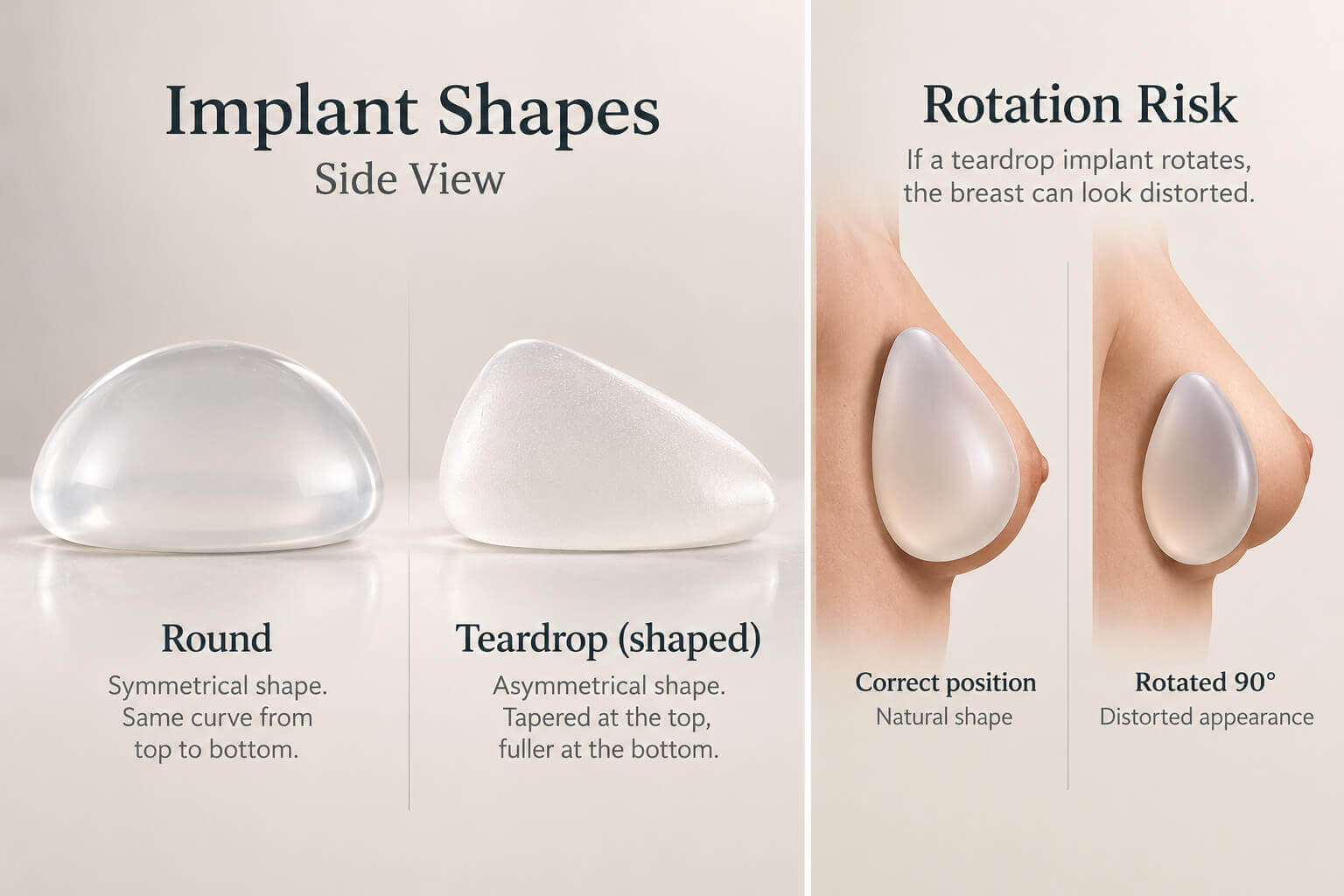
Round implants are symmetrical. Same profile from every angle.
Teardrop implants, also called shaped or anatomic implants, are asymmetrical. They’re fuller at the bottom and taper toward the top, built to imitate the slope of a natural breast.
On paper the teardrop sounds obviously better for anyone wanting a natural result. That was certainly the pitch when they arrived. The reality has turned out more complicated.
The problem with teardrop implants
Every teardrop implant is textured. That isn’t a marketing decision, it’s structural: an asymmetrical implant has a correct orientation, and if it spins inside the pocket the breast distorts visibly. Texturing the shell gives it grip so it stays put.
Texturing is also what created the safety problem.
In July 2019, at the FDA’s request, Allergan issued a worldwide recall of its BIOCELL textured implants after evidence connected them to a rare cancer of the immune system called breast implant-associated anaplastic large cell lymphoma, or BIA-ALCL. The American Cancer Society’s summary of the recall notes the FDA calculated the risk from those implants at roughly six times that of textured implants from other manufacturers.
Two details matter for anyone reading this with implants already in place. The overall risk remains low, and the FDA has not recommended removing textured implants from women who have no symptoms. If you have textured implants and you’re concerned, the appropriate step is a conversation with your surgeon, not surgery.
But for a woman choosing implants today, the calculation is different. As of mid-2024 the FDA had recorded roughly 1,380 confirmed BIA-ALCL cases and 64 deaths, overwhelmingly in patients with textured shells. Smooth implants have not carried that association.
That’s why most plastic surgeons in this country, myself included, stopped offering textured implants for cosmetic breast augmentation, which in practice takes teardrop off the table for augmentation patients.
Rotation, separately
Even setting the texture question aside, shaped implants carry a mechanical risk that round ones don’t.
If a teardrop implant rotates in the pocket, the asymmetry that was supposed to look natural now points the wrong way. The breast can look visibly odd, and correcting it means going back to surgery. A round implant can rotate all it likes and nothing changes, because there’s nothing to rotate out of position.
For a device meant to sit in your body for a decade or more, that’s not a small difference.
“But round implants look fake”
This is the objection I hear most, and it comes from a real place. People have seen results that look obviously done, and assumed the shape was responsible.
It usually wasn’t.
What makes an augmentation look artificial is nearly always a mismatch between the implant and the woman’s frame, or a profile that projects too far forward for the tissue covering it, or placement above the muscle in someone who didn’t have enough coverage for that. A modestly profiled round implant, sized to your actual chest measurements and placed under the muscle, does not read as round on the body. Your own tissue drapes over it and the upper pole slopes.
I’ve written separately about how implant profile shapes that result, and about choosing a volume that suits your measurements. Between those two variables and where the implant sits, you have far more control over how natural the outcome looks than the shape name ever gave you.
What the implant looks like sitting on a table has surprisingly little to do with what it looks like on a person.
Where that leaves the decision
For cosmetic breast augmentation, I use smooth round implants. Silicone or saline depending on the patient, in a profile chosen from her measurements.
Shaped implants still have a place in reconstruction, where the surgeon is rebuilding a breast rather than augmenting one and the trade-offs land differently. That’s a different operation with a different set of priorities.
If you come to a consultation set on teardrop implants, I’ll explain all of this, and I’d rather have that conversation than quietly hand you something you didn’t ask for. Most patients, once they understand that the natural look they want comes from profile and placement rather than from the shape label, stop worrying about it.
Common questions
Are teardrop breast implants safer than round implants?
No. All teardrop implants have a textured shell, and textured implants have been associated with breast implant-associated anaplastic large cell lymphoma (BIA-ALCL). Smooth round implants have not carried that association, which is why most surgeons in the United States now use them for cosmetic augmentation.
Do round breast implants look unnatural?
Not when they are properly chosen. A natural result depends far more on matching the implant’s base width to your chest, selecting an appropriate profile, and placing the implant under the muscle than it does on whether the implant is round or shaped. Your own breast tissue drapes over a round implant and creates a sloped upper pole.
Are gummy bear implants the same as teardrop implants?
No. “Gummy bear” refers to a highly cohesive silicone gel filling that holds its shape. “Teardrop” refers to the external shape of the implant. Cohesive gel is available in round implants as well, so the two terms describe different characteristics.
Should I have my textured implants removed?
The FDA does not recommend removal of textured breast implants in women who have no symptoms, and the overall risk of BIA-ALCL remains low. If you have textured implants and are concerned, or if you notice swelling, pain, or a change in the breast, see your plastic surgeon for evaluation.
Discuss your options in Paramus
Implant shape is one of several decisions we work through at the consultation, and usually the quickest to settle. Our office is on Winslow Place in Paramus, a short drive from anywhere in Bergen County. For an overview of the procedure, see our page on breast augmentation in New Jersey, or call (201) 546-1890 to arrange a consultation.
Medically reviewed by Dr. Michael Gartner, DO, FACS — double board-certified plastic surgeon and Fellow of the American College of Surgeons, practicing in Paramus, New Jersey for over 20 years.