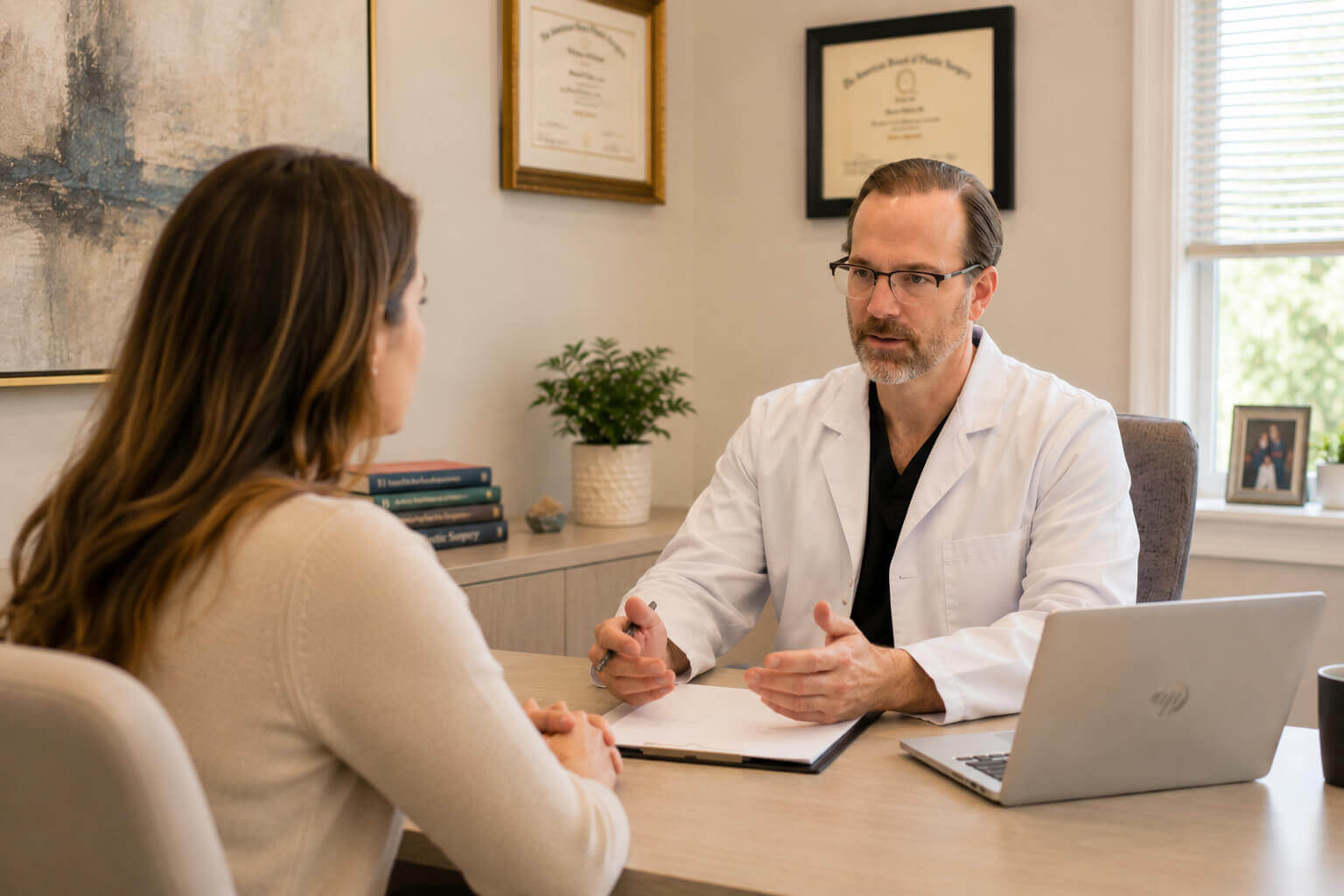
Most people leave a consultation remembering less than they expect to. A review in the Journal of the Royal Society of Medicine found that patients forget 40 to 80 percent of what a doctor tells them almost immediately, and that close to half of what they do remember is wrong (Kessels, 2003). So write your questions down before you come in, and write the answers down while you’re here.
The questions below are grouped by topic. You won’t need every one. Pick the ones that fit your procedure and your situation, and don’t let any surgeon rush you past them, including us.
Questions About Your Surgeon’s Training
Which board certifies you in plastic surgery?
Ask for the name of the board, not just whether the surgeon is “board-certified.” The American Board of Plastic Surgery certifies surgeons who have completed an accredited plastic surgery residency and passed its written and oral exams. Plenty of doctors who perform cosmetic procedures hold certification in other specialties instead, and the wording on a website won’t always make that difference obvious.
You can look up any surgeon’s status on the ABPS website in a couple of minutes. For the record, Dr. Gartner is certified by both the American Board of Plastic Surgery and the American Board of Surgery, and he’s a Fellow of the American College of Surgeons.
How often do you perform this procedure now?
Overall experience matters less than experience with your particular operation. A surgeon who does a dozen facelifts a year and one who does a dozen a month will have different instincts when something unexpected happens on the table. Ask about the specific procedure, and ask how often they do it these days rather than across a whole career.
Questions About the Operation
Which technique would you use on me, and why that one?
Most procedures can be done more than one way. A good answer explains why one approach suits your anatomy better than the alternatives, and it should sound like it came from your exam rather than a script. If the explanation would fit any patient who walked in that day, ask again.
If you’re preparing for breast augmentation in particular, we’ve put together a separate list of questions for a breast augmentation consultation that covers implants, incisions and placement.
What result is realistic for my body?
Ask to see before-and-after photos of patients who started where you’re starting: similar age, similar skin quality, similar build. A gallery full of ideal candidates tells you very little about your own outcome. Be wary of anyone who guarantees a result, since skin, healing and scarring vary from one person to the next.
What are the risks for someone like me?
Every operation comes with a standard list of risks, and you should hear it. The more useful conversation is about how your own history changes that list. Smoking, certain medications, a past blood clot and previous surgery in the same area all shift the picture, so mention them even if they seem minor.
Questions About Where the Surgery Happens
Is the facility accredited and licensed by the state?
This is one of the easiest things to verify, and it’s worth doing. A study of more than 1.1 million procedures performed in accredited office-based surgery facilities, published in Plastic and Reconstructive Surgery, recorded roughly 2 deaths per 100,000 procedures, most of them from pulmonary embolism (Keyes et al., 2008). Accreditation sets standards for equipment, staffing and emergency preparedness that an unaccredited room doesn’t have to meet.
Our surgical facility in Paramus is accredited by the AAAASF and licensed by the State of New Jersey as a surgery center. You can read more about it on our clinic page.
Questions About Anesthesia
Will I be asleep, or can this be done awake?
Many patients assume general anesthesia is the only option. For a number of breast and body procedures it isn’t. Some can be performed while you’re awake, with local anesthetic to numb the area and an oral medication to keep you relaxed. Ask which options exist for your procedure and why the surgeon recommends one over the other.
If I’m having general anesthesia, who manages it?
Ask who will give and monitor the anesthetic, what their credentials are, and whether you’ll meet them before the day of surgery. With general anesthesia, that should be a dedicated anesthesia provider whose only job during the operation is watching you.
If I’m awake, how will you keep me comfortable?
When awake surgery is on the table, this is the question that matters, and the answer should be specific. At our practice, Dr. Gartner gives an oral anti-anxiety medication (Valium) before starting, then numbs the surgical area with a combination of fast-acting and long-acting local anesthetic. Because you aren’t under general anesthesia, there’s no breathing tube and none of the grogginess or nausea that can follow it.
Most patients describe pressure or tugging rather than pain. You can talk with the team throughout, and you go home the same day. An awake breast lift, for example, takes about three hours from start to finish.
Am I a good candidate for an awake procedure?
Not everyone is. It depends on the procedure, how extensive it is and how comfortable you’d be staying aware during it. People who’ve had a hard time waking up from general anesthesia before, or who would simply rather avoid it, are often the ones who ask. Raise it during the consultation, or read how the approach works for awake breast augmentation in Paramus, NJ.
Questions About Recovery
What will the first two weeks actually look like?
Push for specifics. When can you shower, drive, go back to a desk job, pick up a toddler or return to the gym? How will day two feel compared with day seven? Which symptoms mean you should call right away, and which are normal? Knowing this ahead of time makes it easier to plan time off and arrange help at home, and it makes you less likely to overdo things in the second week, when most people start feeling better than they really are.
Who do I call if something worries me on a weekend?
You want a clear answer here, ideally a direct line to the surgical team rather than the main office number. Ask who covers for your surgeon when they’re unavailable, too.
Questions About Cost
What does the quote include, and what could be added later?
Ask for an itemized quote covering the surgeon’s fee, the facility, anesthesia, compression garments and follow-up visits. Then ask what could change the number, such as a revision down the line. Financing is worth asking about too, and we work with both Cherry and CareCredit.
Our consultation fee is $200, and it’s credited toward your surgery if you go ahead. Current procedure pricing is listed on our prices page.
Frequently Asked Questions
Should I get more than one plastic surgery consultation?
Yes, if you have the time. Seeing two or three surgeons lets you compare their recommendations and how clearly each one explains things. Be cautious if a surgeon discourages you from getting another opinion.
What is the difference between board-certified and board-eligible?
Board-eligible means the surgeon has finished residency training but hasn’t yet passed the certification exams. Board-certified means they have passed them. For an elective cosmetic procedure, look for full certification in plastic surgery.
Can I bring someone with me to my consultation?
Yes, and it’s a good idea. A second person can take notes, catch details you miss and ask questions you didn’t think of. If you’re considering an awake procedure, it helps for the person driving you home to hear what the day involves.
If you’d like to go through these questions with Dr. Gartner, book a consultation at our Paramus office or call (201) 546-1890.
References
- Kessels RPC. Patients’ memory for medical information. Journal of the Royal Society of Medicine. 2003;96(5):219-222.
- Keyes GR, et al. Mortality in outpatient surgery. Plastic and Reconstructive Surgery. 2008.